
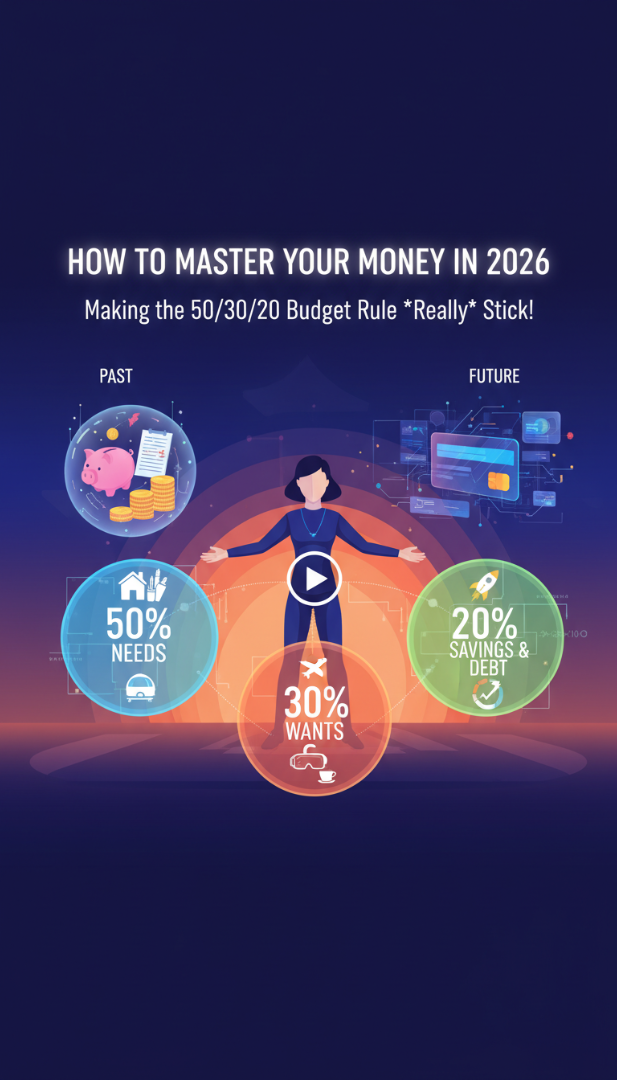
Money management often feels like a second job. Between tracking daily latte purchases, monitoring fluctuating subscription costs, and stressing over retirement contributions, it’s easy to feel overwhelmed. Complex spreadsheets and restrictive apps often lead to “budget burnout” within a month. But effective financial planning doesn’t have to be complicated. In fact, the most successful budgets are often the simplest.
Enter the 50/30/20 budget.
This proportional budgeting method has stood the test of time because it prioritizes psychology over penny-pinching. It doesn’t ask you to stop living; it asks you to balance your life. However, applying this rule in 2026—an era of shifting economic landscapes, digital currencies, and variable living costs—requires a modern approach.
This guide will walk you through exactly how to build a 50/30/20 budget that is realistic, flexible, and designed to stick long-term, helping you build wealth without sacrificing your happiness.
What is the 50/30/20 Rule?
The 50/30/20 rule is a percentage-based budgeting framework popularized by Senator Elizabeth Warren in her book All Your Worth: The Ultimate Lifetime Money Plan. Unlike zero-based budgeting, where you assign every dollar a specific job, this method divides your after-tax income (net income) into three broad buckets.
This simplicity reduces decision fatigue. Instead of categorizing 50 different line items, you only need to worry about three.
1. 50% Needs (The Essentials)
Half of your income goes toward the bills that you absolutely must pay to survive and work. These are your non-negotiables. If you lost your job tomorrow, these are the expenses you would still need to cover.
- Includes: Rent or mortgage, utilities (electricity, water, internet), groceries (basic food, not dining out), transportation (car payment, gas, public transit), and minimum debt payments.
- The 2026 Reality: With housing costs remaining high in many areas, keeping this under 50% is the biggest challenge for most people.
2. 30% Wants (The Lifestyle)
This is the category that makes the budget sustainable. It covers the things that aren’t essential for survival but are essential for your happiness and quality of life.
- Includes: Dining out, streaming subscriptions (Netflix, Spotify), hobbies, gym memberships, vacations, upgrading electronics, and entertainment.
- Key Distinction: A standard internet connection is a need (for work/connectivity), but the highest-tier fiber optic package might be a want.
3. 20% Savings & Debt Repayment (The Future)
The final 20% is paid to your future self. This bucket builds your financial foundation and secures your freedom.
- Includes: Emergency fund contributions, retirement investing (401k, IRA), extra debt payments (beyond minimums), and saving for specific goals like a down payment or a wedding.
Step-by-Step Guide to Building Your 2026 Budget
Creating the budget is the easy part; the challenge is setting it up correctly so you don’t have to constantly tweak it.
Step 1: Calculate Your True Net Income
You cannot budget off your gross salary. You need to know exactly what hits your bank account.
- For Employees: Look at your paystubs. Your net income is the amount deposited after taxes, health insurance, and pre-tax deductions.
- For Freelancers/Gig Workers: Estimate your average monthly income and subtract 25–30% for taxes immediately. Use the remaining amount as your “net income” for this calculation.
Step 2: Audit Your Past 3 Months
To categorize accurately, you need data. Review your bank statements and credit card bills from the last 90 days.
- Group every expense into Needs, Wants, or Savings.
- Tip: Be honest. That daily $15 lunch is a “Want,” not a “Need,” even if you feel you need it to survive the workday.
Step 3: Apply the Percentages
Let’s use an example of a monthly net income of $4,000.
- Needs (50%): $2,000 max.
- Wants (30%): $1,200 max.
- Savings (20%): $800 min.
If your current spending doesn’t match these numbers (e.g., your needs are at 65%), don’t panic. We will address adjustments in the next section.
Why Budgets Fail (And How to Make Yours Stick)
Most people abandon their budgets because they are too rigid or manual. In 2026, we have the technology to automate discipline. Here is how to ensure your plan succeeds.
1. Automate the 20% First (“Pay Yourself First”)
The most common mistake is saving what is left over at the end of the month. Usually, nothing is left.
- The Fix: Set up an automatic transfer on payday. Move your 20% (or whatever amount you start with) directly into a separate high-yield savings account or investment portfolio. If you never see it in your checking account, you won’t spend it.
2. Separate Your “Wants” Money
Mixing your “Wants” money with your “Needs” money is a recipe for disaster.
- The Fix: Use a separate checking account or a prepaid debit card for your 30% spending money. Once that account hits $0, your discretionary spending for the month is done. This provides a hard stop without you having to track every coffee purchase manually.
3. The “Inflation Adjustment” for Needs
If you live in a high-cost-of-living area, spending only 50% on needs might be mathematically impossible right now.
- The Fix: Modify the ratio, not the habit. A 60/20/20 or 70/20/10 budget is better than no budget. If your needs consume 60% of your income, you must reduce your Wants to 20%. Protect the Savings category as much as possible—it is your exit strategy from financial stress.
Distinguishing Needs vs. Wants in 2026
The line between necessity and luxury has blurred. Here is a modern cheat sheet to help you categorize expenses:
| Expense | Category | Why? |
| Groceries | Need | Essential nutrition. |
| Uber Eats / DoorDash | Want | Service fees and markups are luxuries. |
| Basic Internet | Need | Required for most employment/banking. |
| Hulu / Netflix / Disney+ | Want | Entertainment. Choose 1 or 2, cut the rest. |
| Gym Membership | Want | You can exercise for free (mostly), though health is vital. |
| iPhone Payment | Mixed | A functional phone is a Need; the latest Pro Max model is a Want. |
| Therapy/Healthcare | Need | Mental and physical health are maintenance costs. |
Tools to Streamline Your 50/30/20 Budget
You do not need to be a spreadsheet wizard to make this work. In 2026, leverage tools that do the heavy lifting for you.
- Spreadsheets (Google Sheets/Excel): Best for people who want total control and privacy. There are thousands of free 50/30/20 templates available.
- Budgeting Apps (YNAB, Monarch, PocketGuard): These link to your bank accounts and auto-categorize transactions. Look for apps that allow you to set “percentage-based” targets rather than just dollar amounts.
- The “Two-Account” Method: As mentioned earlier, keeping bills in one account and spending money in another is the ultimate low-tech, high-success tool.
Frequently Asked Questions
1. Does the 50/30/20 rule apply to gross or net income?
It applies to net income (what actually hits your bank account). However, if you have contributions deducted from your paycheck automatically (like a 401k), you should add those back into the “Savings” percentage to get a true picture of your 20%.
2. What if my debt payments are huge?
If you have high-interest debt (credit cards), your “20% Savings” category should be almost entirely dedicated to debt repayment. Minimum payments count as “Needs,” but anything extra comes from the “Savings/Debt” bucket.
3. Can I change the percentages?
Absolutely. The 50/30/20 is a guideline, not a law. If you are aggressively saving for a house, you might switch to 50/10/40. If you are struggling with low income, you might be at 70/20/10. The goal is simply to have defined caps on your spending.
4. Where do irregular expenses (like car repairs) go?
These should come from your Sinking Funds (part of your 20% savings). You save a little every month into a “Car Repair” fund so that when the bill comes, it doesn’t wreck your “Needs” budget for that month.
Conclusion
The beauty of the 50/30/20 budget lies in its refusal to demand perfection. It allows you to enjoy your life today (the 30%) while protecting your life tomorrow (the 20%).
In 2026, financial success isn’t about tracking every single penny; it is about creating a system that manages your money for you. By automating your savings and clearly defining your boundaries, you can stop stressing about the math and start focusing on your goals.
Your Action Plan for Today: Log into your bank account, look at your last paycheck, and calculate your three numbers (50%, 30%, and 20%). Then, set up one automatic transfer for your savings bucket. That single action puts you ahead of the majority of the population.